 How-to
How to Style Geometric Abstract Art in a Living Room
Quick Summary
Style geometric abstract art by choosing a print that repeats one or two colors already in your room, such as the rug, sofa or pillows. Hang it centered above the sofa, spanning about two-thirds to three-quarters of the sofa's width.
- Pick a print with a dominant color matching your largest fabric or wall.
- Choose artwork spanning two-thirds to three-quarters of the sofa's width.
- Hang the center of the artwork 57 to 60 inches from the floor.
- Keep 6 to 10 inches between the frame bottom and the sofa back.
- Keep 2 to 3 inches between gallery frames, edge to edge, consistently.
Table of Contents
- Choosing Geometric Abstract Art That Fits Your Living Room Palette
- Sizing and Placing Geometric Art Above Your Sofa
- Arranging a Geometric Art Gallery Wall Layout
- Previewing Your Pieces and Hanging Them Right the First Time
- Frequently Asked Questions
Choosing Geometric Abstract Art That Fits Your Living Room Palette
Last Updated: November 24, 2026
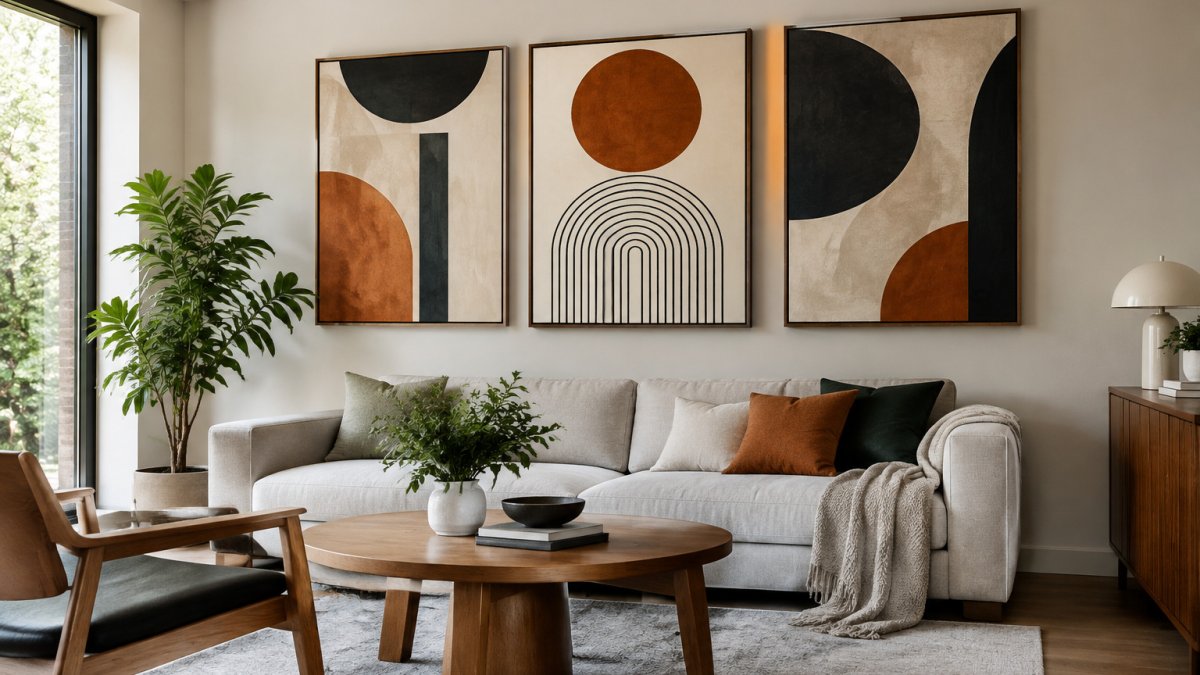
Geometric abstract art works best when it picks up one or two colors already in your room. Start with the rug, sofa or throw pillows, then find a print that repeats those tones. Jackson Smart Art curates fine art prints with rhythm and movement for contemporary spaces.
Look for three things in each print:
- A dominant color that matches your largest fabric or wall.
- An accent color that echoes a smaller object, like a vase or lamp.
- Shapes with clean edges that suit a modern room.
A common mistake is choosing a piece too bold for the room's size. Bright reds and blues can overwhelm a small space, so balance them with a neutral background.
Browse Vibrant Geometric Harmony to see warm and cool tones in one composition; Vibrant Geometric Symphony offers layered shapes in a comparable range.
Sizing and Placing Geometric Art Above Your Sofa
A geometric print above a sofa must anchor the seating area and keep its crisp shapes readable from across the room, so get width and hanging height right before color.
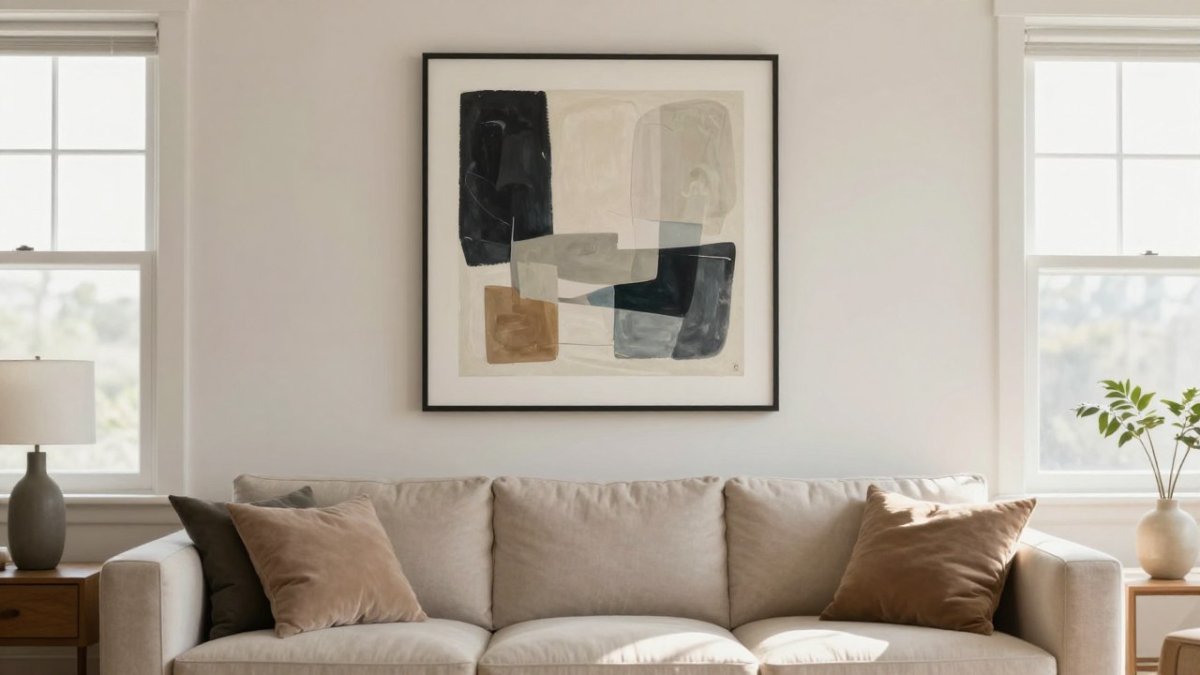
Width. Choose artwork spanning about two-thirds to three-quarters of the sofa's width, 56 to 63 inches on a standard 84-inch sofa. Narrower than half looks stranded; wider feels like a headboard. For a pair, match the combined outer width, frames plus gap, to the sofa.
Hanging height. Most designers hang the center 57 to 60 inches from the floor. Above a sofa, keep 6 to 10 inches between the frame bottom and the sofa back.
Fireplaces and consoles. Above a mantel, keep artwork no wider than the mantel with 4-6 inches of clearance above the shelf. Above a console, match the artwork's outer width to roughly two-thirds of the console width and keep the bottom edge 6-8 inches above the top.
Installation basics. A 20-to-40 pound framed print needs a wall anchor rated for at least twice that weight; drywall alone won't hold it on a single nail. Use two hangers spaced a few inches apart so the piece can't pivot. Adhesive strips work for lightweight canvas and unframed prints, check the rating against actual weight, not size.
!A bright contemporary living room with a neutral sofa and a large geometric abstract print hung centered above it, warm natural light from a nearby window
Watch out: hanging art too high is the most common placement error, it detaches the piece from the furniture below and leaves a dead band of wall.
The article gives these sizing and placement figures for hanging geometric art above a sofa.
| Item | Value | Note |
|---|---|---|
| Artwork width vs. sofa | 2/3 to 3/4 of sofa width | 56 to 63 in on an 84 in sofa |
| Hanging height (center) | 57 to 60 in from floor | Standard designer guidance |
| Gap above sofa back | 6 to 10 in | Frame bottom to sofa back |
| Mantel artwork clearance | 4 to 6 in | Above the mantel shelf |
| Console artwork width | About 2/3 of console width | Bottom edge 6 to 8 in above console |
| Wall anchor rating | At least 2x piece weight | For 20 to 40 lb framed prints |
Arranging a Geometric Art Gallery Wall Layout
Geometric abstract art is unforgiving on a gallery wall: hard edges and strong internal lines make loose, organic arrangements look chaotic. Pick a layout structure first, then choose prints that echo each other's shapes.
Pick a layout structure. Three patterns cover most living rooms:
- Grid. Frames in rows and columns with equal gaps; best when prints share a size or shape family. A 2-by-2 grid of square frames reads as a single unit.
- Salon (floor-to-ceiling). Mixed sizes with consistent gaps, anchored by one large piece; suits tall walls and high ceilings.
- Centerline. One large piece with smaller frames balanced symmetrically on either side; safest for a wall you see on entering.
Spacing math. Keep 2 to 3 inches between frames, edge to edge, consistently. Treat the outer boundary as a single rectangle and center it on the wall or furniture below. For a grid, measure total width plus gaps, divide by two to find the centerline, and mark it with painter's tape.
Make the geometry talk to itself. Repeat one shape across at least two prints so the eye finds a rhythm. Keep the palette to two or three colors; five unrelated color stories read as noise. Vary scale rather than style, one large, two medium, two or three small, and keep every frame in the same finish so the shapes carry the interest.
- Above an 84-inch sofa, 2-by-2 grid: four 18-by-24 inch frames with 2-inch gaps produce a 42-by-54 inch arrangement, narrower than the two-thirds rule, so scale up to 24-by-30 inch frames or add a fifth piece.
- Above a 60-inch console, centerline: one 30-by-40 inch anchor with two 12-by-16 inch frames per side, 2-inch gaps, roughly 74 inches wide, trim to one small frame per side if narrower.
- Tall wall, salon: anchor a 36-by-48 inch piece at center, build outward with 16-by-20 and 11-by-14 inch frames, holding the 2-to-3 inch gap.
Preview before you drill. Lay frames on the floor in the exact arrangement, tape paper templates to the wall at planned heights, and step back to the main seating position. Adjusting paper is cheaper than patching drywall.
If you buy a set, Colourful Geometry makes a bold addition that pulls the wall together with bright, repeated shapes.
Watch out: mixing frame finishes, black, brass, and white, splits attention away from the geometric shapes and makes even a well-spaced wall look assembled rather than designed.
Previewing Your Pieces and Hanging Them Right the First Time
Before you put a nail in the wall, preview the piece using Jackson Smart Art's augmented reality feature, which lets you see how a print looks on your wall before buying.
Then tape a paper template of the print to the wall, step back to the seating spot, and adjust until the piece feels centered.
For a bold centerpiece, Big Red Orbit can anchor a room with strong color. Preview it on your wall first to confirm it fits your space.
Ready to find the right piece for your room? Explore the Jackson Smart Art collection and preview artwork on your wall before you buy.
Frequently Asked Questions
How high should you hang abstract art above a sofa?
A common starting point is to hang the center of the piece about 8 to 10 inches above the top of the sofa back, so the artwork feels connected to the furniture rather than floating. For a sofa about 84 inches wide, aim for a piece roughly two-thirds of that width, around 50 to 60 inches, to keep the composition balanced. Before you drill any holes, tape a paper template of the piece to the wall and step back across the room to check the height and visual weight.
How do you choose the right size geometric abstract art for a living room?
Match the artwork to the furniture it hangs above and the wall space around it. A large piece creates a strong focal point in a bigger room, while a smaller piece in a small living room can get lost, so a medium-to-large print usually works better. Leave clear wall space on either side and avoid crowding the edges of the wall. Using a tape-and-paper mockup helps you confirm the scale before you buy.
Can geometric abstract art work in a small living room?
Yes. In a small room, choose one bold geometric piece with restrained colors rather than several busy prints, which can make the space feel crowded. Repeating one or two accent colors from the piece in a pillow or throw ties the art into the room and creates visual balance. Keep the artwork at a height that does not cut into the ceiling line, since leaving negative space around the piece keeps the room feeling open.