 Ultimate guide
How to Verify Authentic Art Provenance Before You Buy
Last Updated: November 22, 2026
Quick Summary
To verify authentic art provenance, trace the documented ownership chain from the artist's studio to the present using the catalogue raisonné, auction records, museum and exhibition records, and stolen-art registries. Match every document to the physical work, and treat unexplained gaps as questions to resolve before you buy.
- Provenance, authenticity, attribution, and legal title are separate questions you must verify individually.
- A bill of sale should name seller, buyer, date, price, and the artwork's identifying details.
- Search auction databases by artist, title, and dimensions, recording sale date, lot number, and result.
- Document every registry you search, including negative results, as part of your due diligence.
- Bring in art authentication services when value is significant and the attribution is contested.
Table of Contents
- What Art Provenance Means and Why It Decides Value
- A Real Art Provenance Example: Tracing a Painting From Studio to Sale
- The Documents That Build a Chain of Ownership
- What a Letter of Provenance Example Should Contain
- How to Verify Authentic Art Provenance Online
- Matching Documents to the Artwork: Signatures, Labels, and Physical Evidence
- Previewing Your Verified Piece on Your Own Wall
- Frequently Asked Questions
What Art Provenance Means and Why It Decides Value
Art provenance is the documented record of an artwork's ownership history, from the moment it left the artist's studio to the present day (Ownership/Collecting History). A clean, continuous record answers the question every buyer should ask: where has this piece been, and who has owned it?
Provenance is not a nice-to-have certificate tucked in a folder. It is the evidence trail that separates a work with a verifiable past from one with an unexplained gap.
Provenance Versus Authenticity, Attribution, and Legal Title
These four terms get used interchangeably in sales listings, and that confusion costs buyers real money.
- Provenance is the ownership record: who owned the work, when, and how it changed hands.
- Authenticity is whether the work was actually made by the artist it is credited to.
- Attribution is the scholarly opinion about who made it, which can range from "by the artist" to "workshop of" or "circle of."
- Legal title is the legal right to own and sell the piece, independent of whether it is genuine.
A painting can have perfect provenance and still be misattributed. It can be authentic yet have a title clouded by a theft decades ago. Treat each as a separate question, and verify each one on its own terms.
A Real Art Provenance Example: Tracing a Painting From Studio to Sale
Picture a mid-century abstract canvas. The dealer says it came "from a private collection." That phrase tells you almost nothing. A proper trace looks like this:
- The artist's studio records or estate inventory list the work with its title, date, and dimensions.
- A gallery invoice shows the first sale, naming the buyer.
- An auction catalog from a later sale lists the same title and dimensions, with the buyer's name in the results.
- A bill of sale transfers it to the current owner.
Each step should match the last on title, date of creation, medium, and dimensions. When the chain holds, the example is worth trusting. When a link is missing, you have a question to ask, not necessarily a reason to walk away.
The Documents That Build a Chain of Ownership
A credible chain of ownership rests on paperwork that cross-checks against itself. No single document proves a work's history; the strength comes from documents that confirm one another.
Bills of Sale, Invoices, and Transfer Records
A bill of sale should name the seller, the buyer, the date, the price, and the artwork's identifying details: title, medium, dimensions, and any inventory number. Invoices from galleries and auction houses serve the same purpose. Look for consistency across documents. A common mistake is accepting a typed "letter of provenance" with no supporting invoice behind it. Paperwork that cannot be tied to a real transaction is decoration, not evidence.
Exhibition History, Auction Records, and Gallery Records
Exhibition history places the work in a specific place at a specific time, which corroborates ownership. Auction records show public sales with dates and prices. Gallery records and artist records fill in private transactions. Cross-check all three: if a painting supposedly hung in a museum show in a given year, the exhibition catalog should list it. What most guides miss is that these records must match the physical work, not just each other.
What a Letter of Provenance Example Should Contain
A strong letter of provenance example includes the following, and nothing vague:
- The artwork's title, artist, date of creation, medium, and dimensions
- The full chain of ownership with dates and names
- References to supporting documentation: invoices, bills of sale, exhibition catalogs
- The author of the letter and their relationship to the work
- A signature and date
If a seller hands you a letter with no names, no dates, and no document references, treat it as a claim rather than proof. Ask for the underlying records.
How to Verify Authentic Art Provenance Online
Most guides tell you to "check the catalogue raisonné and auction databases" and stop there. That is a list of sources, not a method. What follows is a repeatable, source-by-source workflow you can run in a single sitting and document as you go, so your online research produces an evidence trail rather than a pile of browser tabs.
Step 1: Start With the Artist Record
Begin with the artist's catalogue raisonné, the definitive scholarly catalog of the artist's known works, and the artist's foundation or estate archive. Search by title, date, medium, and dimensions, not just the artist's name. Record the catalog volume, entry number, and page for any match, plus the exact title and dimensions the catalog lists.
Watch out: a dealer's claim that a work is "listed in the catalogue raisonné" is not the same as you finding the entry yourself, verify the entry number and volume before you rely on it.
Step 2: Search Auction Databases for Prior Sales
Search the major auction house databases and price archives by artist, title, and dimensions. Auction records are among the most reliable public evidence because they capture a dated, priced, public transaction. For each hit, record the sale date, auction house, lot number, title as cataloged, dimensions, and the result if published. A prior sale that matches the work in front of you corroborates the chain; a prior sale with different dimensions or a different title is a question to resolve, not a disqualifier.
Step 3: Check Museum and Exhibition Records
Museum collection databases and exhibition catalogs place a work in a specific place at a specific time. Search the museum's online collection and the published exhibition catalog for the year and venue the seller claims. Record the exhibition title, venue, dates, and catalog page. If a painting supposedly hung in a museum show, the catalog should list it, and the catalog's title and dimensions should match the work.
Step 4: Run Reverse-Image and Registry Searches
Reverse-image search can help surface clear photographs of the front and back of a work, including labels and inscriptions, in other listings. This can surface the same piece in an auction listing, a gallery page, or a stolen-art registry. Then search the major stolen-art registries and the auction houses' own stolen-property databases by artist and description. Record every registry you searched, the date, and the result, including negative results, because a documented search is part of your due diligence.
Step 5: Build a Timeline and Confirm Each Entry
Lay every hit on a single timeline: creation date, first sale, exhibitions, auction sales, and current ownership. Each entry should be backed by a document or a citable record, not a memory or a verbal assurance. Where the online record is thin, mark the gap explicitly and carry it into your evidence log.
The Limits of Digital Records
Digital research narrows the questions; it does not answer them. Many older transactions were never digitized, and gaps from the pre-digital era are common and not automatically suspicious. When the records are thin, our guide to art prints starting at $40.60 shows how a verified piece is presented with transparent detail.
Here is the source-by-source workflow the article lays out for verifying provenance online.
| Step | What to do | What to record |
|---|---|---|
| 1 | Search the catalogue raisonné and artist foundation or estate archive | Catalog volume, entry number, page, exact title and dimensions |
| 2 | Search major auction house databases and price archives | Sale date, auction house, lot number, title, dimensions, result |
| 3 | Check museum collection databases and exhibition catalogs | Exhibition title, venue, dates, catalog page |
| 4 | Run reverse-image and stolen-art registry searches | Every registry searched, the date, and the result |
| 5 | Build a timeline and confirm each entry | Each entry backed by a document or citable record |
Matching Documents to the Artwork: Signatures, Labels, and Physical Evidence
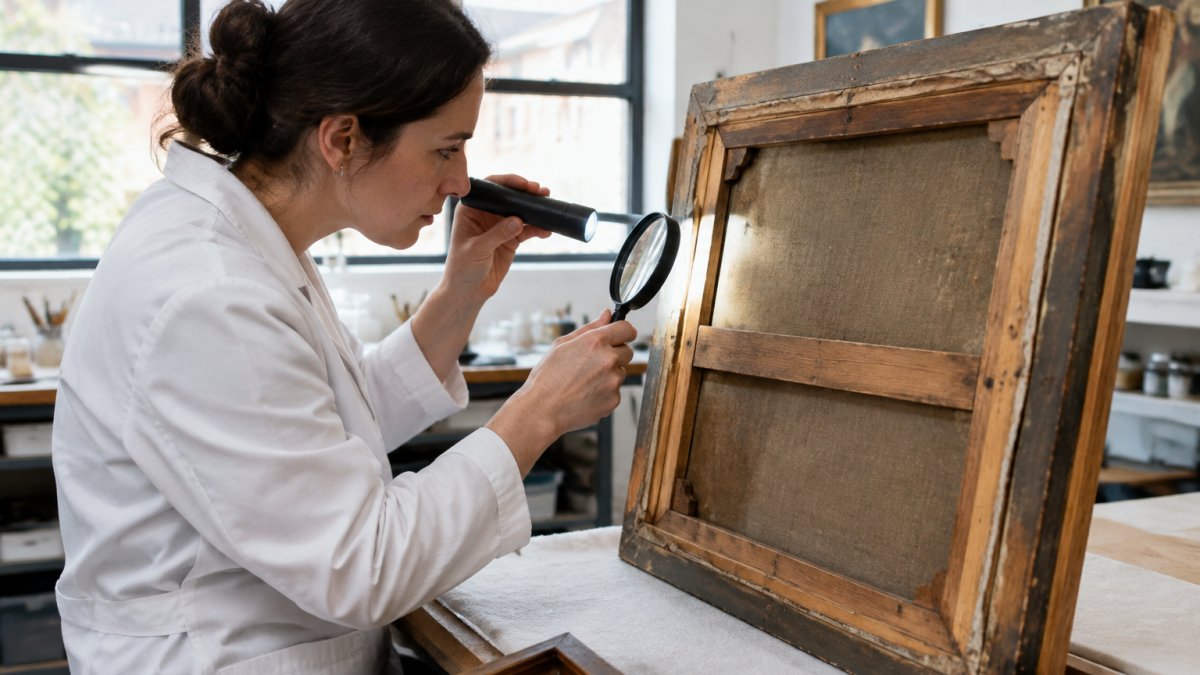
- Catalogue raisonné entry checked
- Chain of ownership traced with dates and names
- Bills of sale and invoices collected and cross-checked
- Exhibition history and auction records verified
- Certificate of authenticity reviewed against the work
- Artist signature, labels, stamps, and inscriptions examined
- Stolen-art registries checked
- Gaps identified and explained in writing
- Legal title and sale terms confirmed in writing
Record each document's source, date, and what it proves. A tidy evidence log makes a specialist's review faster and gives you a record if a dispute arises later.
Previewing Your Verified Piece on Your Own Wall
Once the provenance holds up, the next question is how the piece will look in your space. Compare formats and pricing across pieces like Chromatic Chant and Disturbed Point of View, or start with Three Circles Sit Down At A Bar to see how print options work.
Verifying provenance takes patience, but it is the difference between buying art and buying a story. Jackson Smart Art makes the final step easier with augmented reality wall previews, a secure verified checkout, and original rhythm-inspired pieces you can see in your space before you commit.
Frequently Asked Questions
How do you prove the provenance of an artwork?
Build a documented chain of ownership from the artist's studio to the present day. Gather bills of sale, invoices, gallery records, auction catalogs, exhibition history, and any certificate of authenticity. Cross-check names, dates, and inventory numbers across documents, then compare those details to the physical work. A continuous, verifiable paper trail carries the most weight; gaps are not automatically disqualifying, but each one needs a plausible explanation you can confirm with a specialist.
What is the difference between provenance and authenticity?
Provenance is the recorded ownership history of an artwork: who owned it, when, and how it changed hands. Authenticity is a judgment about whether the work was actually made by the artist it is attributed to. Strong provenance supports authenticity, but it does not prove it. A well-documented history can still attach to a forgery, and a genuine work can lack paperwork. Treat provenance as evidence and authentication as the conclusion, ideally confirmed by art authentication services.
Can you verify art provenance online?
Partially. You can check auction archives, museum collection databases, gallery websites, and catalogue raisonné records online, and run reverse image searches to spot duplicated listings. What you cannot do online is examine the physical object, its signature, or its paper and canvas aging. Use online research to build a timeline and flag inconsistencies, then verify the physical details in person or through a qualified specialist before you commit to a purchase.
What should I do if an artwork has no provenance paperwork?
Do not walk away automatically, but adjust your risk and your price. Ask the seller for any supporting documentation: purchase receipts, emails, photographs of the work in place, or prior appraisals. Request a written statement of how they acquired it. Have a specialist examine the work and consider art authentication services. Undocumented pieces can be legitimate, but you should pay less, get the sale terms in writing, and confirm legal title before money changes hands.
What documents can help establish an artwork's provenance?
The strongest set includes a bill of sale or invoice for each transfer, gallery and dealer records, auction catalogs and results, exhibition history, insurance appraisals, and a certificate of authenticity from the artist or estate. A letter of provenance example should name the work, its title, date, medium, and dimensions, state the ownership chain, and be signed and dated. Inventory numbers, labels, and stamps on the reverse of the work help tie those documents to the object itself.